Home Gym · 8 Min Read
Here's How This Weird $49 Invention Turned My Dad's Old Plates Into A Full Dumbbell Set
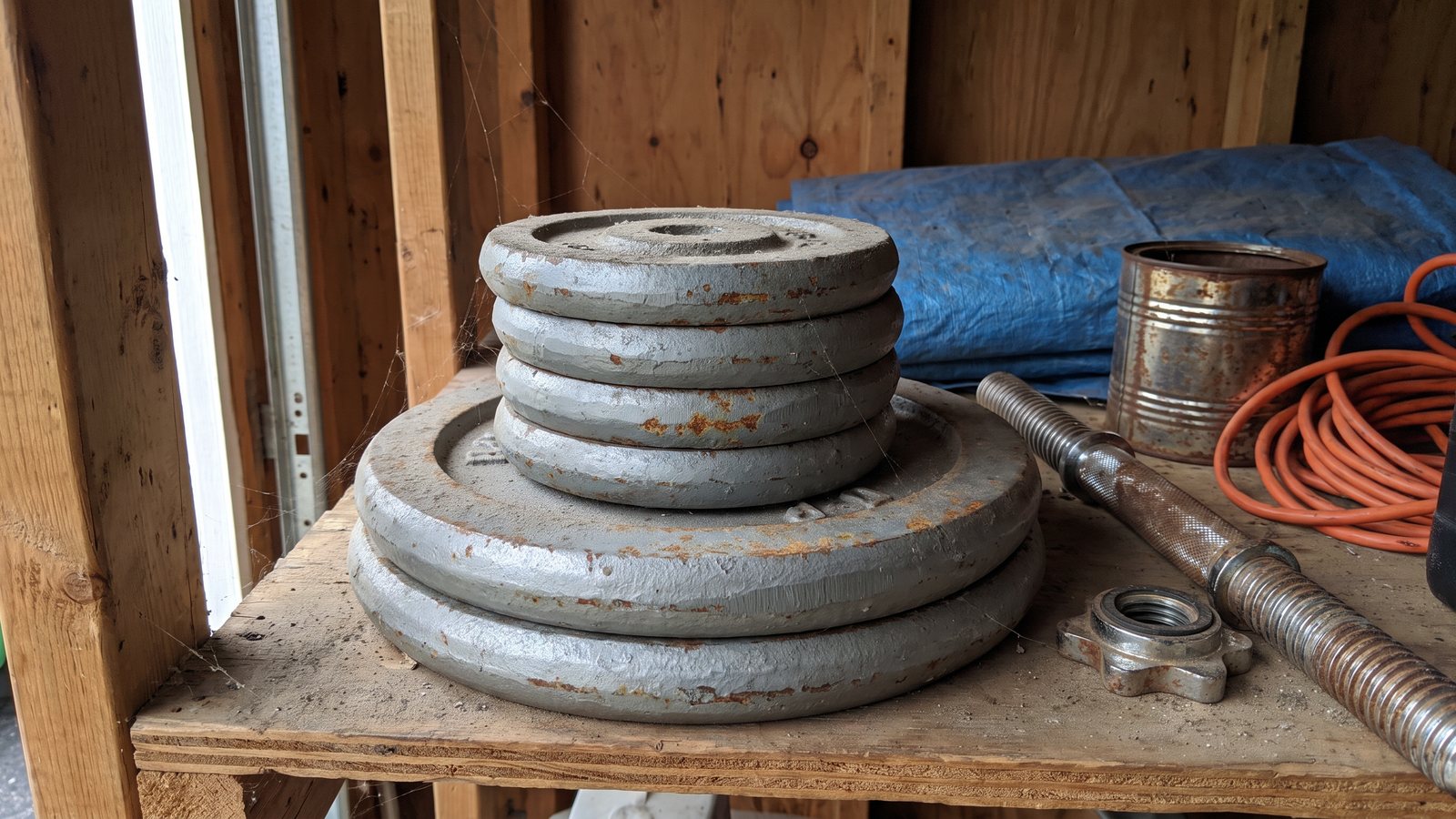
Dad had a $549 set of adjustable dumbbells in his cart. Six feet behind him sat 130 pounds of grey iron plates he had not touched in about 20 years. A strange looking $49 pair of handles turned those plates into every dumbbell pair from 5 to 35 pounds. Here is how, including the two plates that would not go on.

The Cart Said $549. The Shelf Said 130 Pounds.
Dad texted me a link on a Sunday night with one line under it. "Is this the one?"
It was a PowerBlock Pro 50, a pair of adjustable dumbbells that runs from 5 to 50 pounds a hand. The price was $549. He had decided he wanted to lift again. Not a gym, not an app. Just dumbbells in the garage, the way he trained when I was a kid. He wanted to be lifting again before the weather turned.
I remember the sound of that old set. Spin collars rattling on the threads, and every so often a plate hitting the concrete when one worked loose.
I drove over that Saturday. His garage looks the way it always has. A workbench, a lawnmower, coffee cans full of screws. On the second shelf, under dust thick enough to write your name in, sat his old weight set.
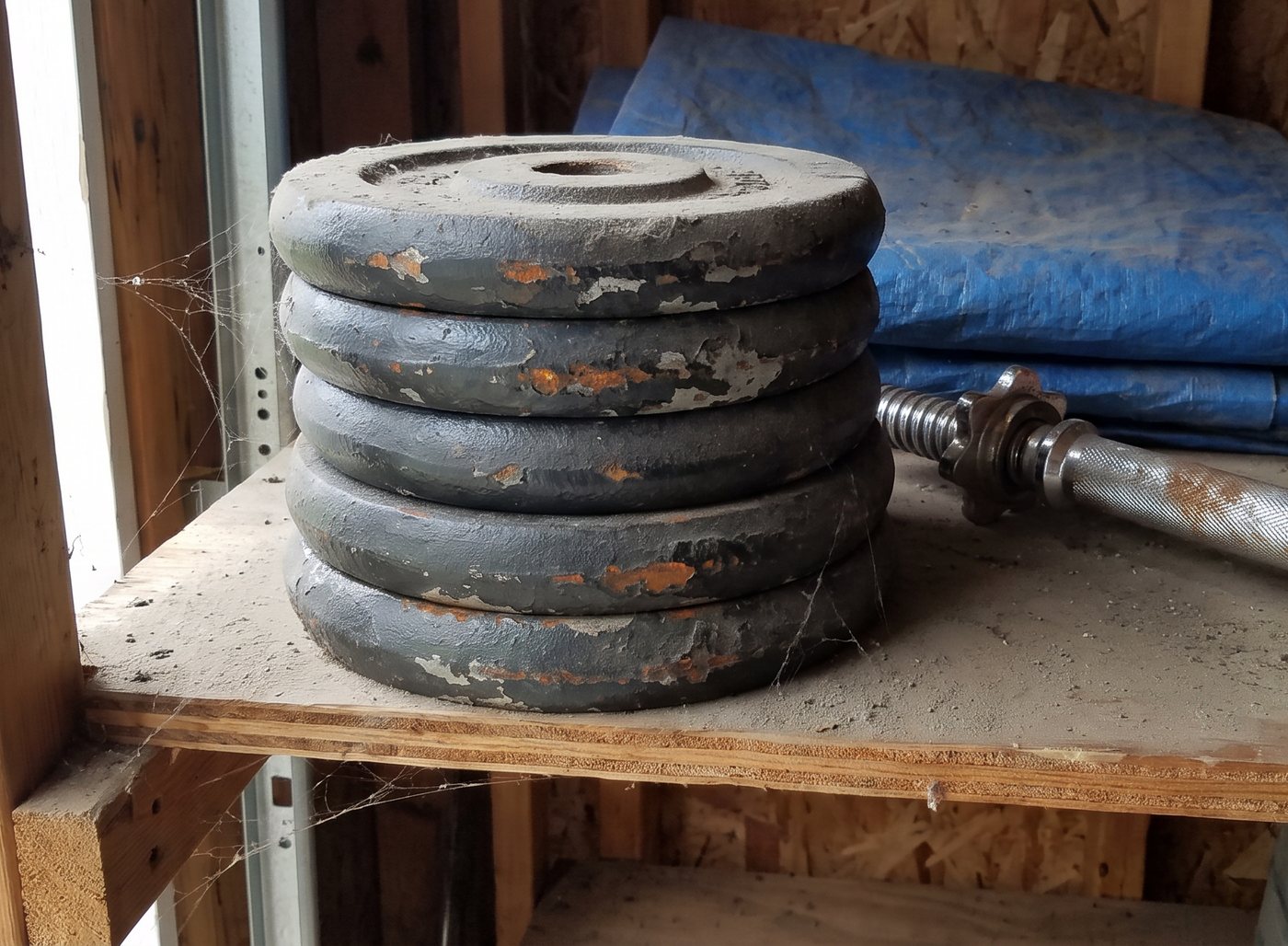
The plates had not moved since around 2005. Nothing was wrong with them. The paint was chipped and the rims had some orange rust, but a 10 pound plate from the 1990s still weighs 10 pounds. What went wrong was everything around them.
Sold, the stack would bring less than $100. As dumbbells, it could do most of what that $549 set does.
Three Ways To Get Dumbbells Out Of A Garage Like This
Before he bought anything, we priced every sensible route, each checked on the seller's own site this week. Each one wins something outright.
Put the old spinlock handles back to work
$0 to $32.99
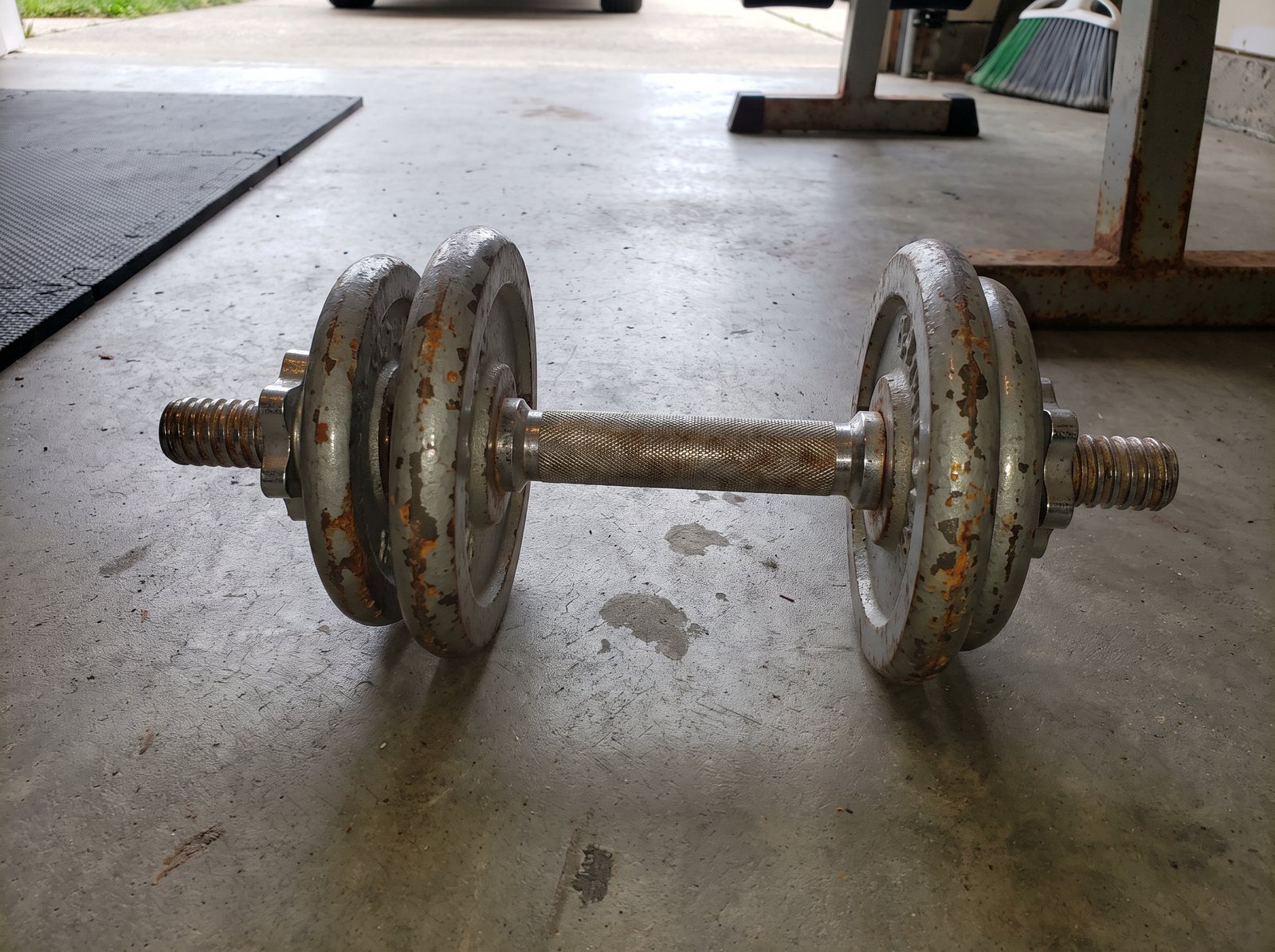
His two chrome handles still screwed together. One star collar was gone, and a new pair of CAP standard threaded handles costs $32.99. This is the cheapest route here. It also fits everything: a spinlock bar is one inch thick, so any plate sold as standard slides on, and CAP rates each bar for 100 pounds.
It is also why the set went on the shelf. Dad says the collars never stayed put. A few sets of rows and a collar walks loose, and the plates start to clank. The bar also sticks out several inches past the plates on both ends, so you cannot rest the dumbbell on your thighs to get into a press without the threads digging in.
Wins: price, and it fits every plate with a one inch hole.
Buy the dial set and leave the plates on the shelf
$399 to $599
The PowerBlock in his cart moves a magnetic pin and changes weight in a couple of seconds, 5 to 50 pounds a hand, for $549. A Bowflex SelectTech 552 turns a dial from 5 to 52.5 pounds. It was $399 on sale this week and lists for $479. A NÜOBELL 550 twists its handle to any weight from 5 to 50 pounds in 5 pound steps, and costs $599 a pair.
Dad liked the PowerBlock for a real reason. He wanted to change weight between sets without thinking about it. These win on speed, and it is not close. If you change weight between every set, nothing that runs on loose plates keeps up with a dial. What they cannot do is use a single plate you own. Every one of them would have left 130 pounds of iron on that shelf, and Dad would have paid $399 to $599 for weight he already had.
Wins: the fastest weight change you can buy.
Buy a rack of fixed dumbbells
$699.99 and up
CAP sells rubber hex pairs from 5 to 50 pounds with a two tier rack for $699.99. Titan's 5 to 50 pound rubber hex set is $1,129.97. Fixed dumbbells win on the one thing both other routes lose on. Nothing adjusts and nothing comes loose. You grab the next pair and go.
They also need a rack's worth of floor, and the plates would still sit on the shelf.
Wins: nothing to adjust, nothing to loosen, ever.
What Old Plates Need To Work As Dumbbells
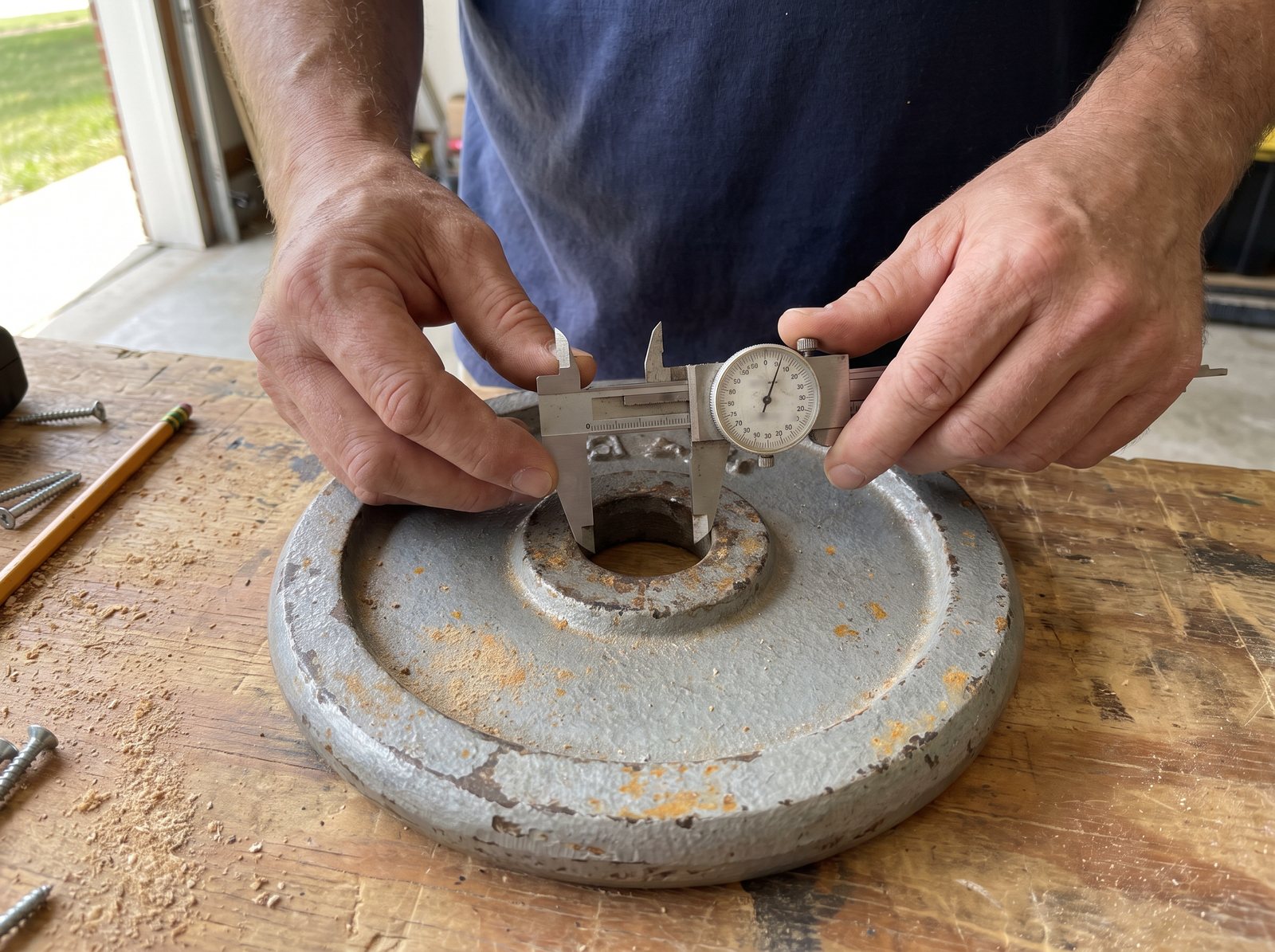
Standing in that garage, the question changed. It stopped being which dumbbells to buy and became what it would take for these plates to be dumbbells again. It came down to four things. They are worth checking on any old set before you spend a dollar, and here they are in the order we ran them.
-
The hole has to fit
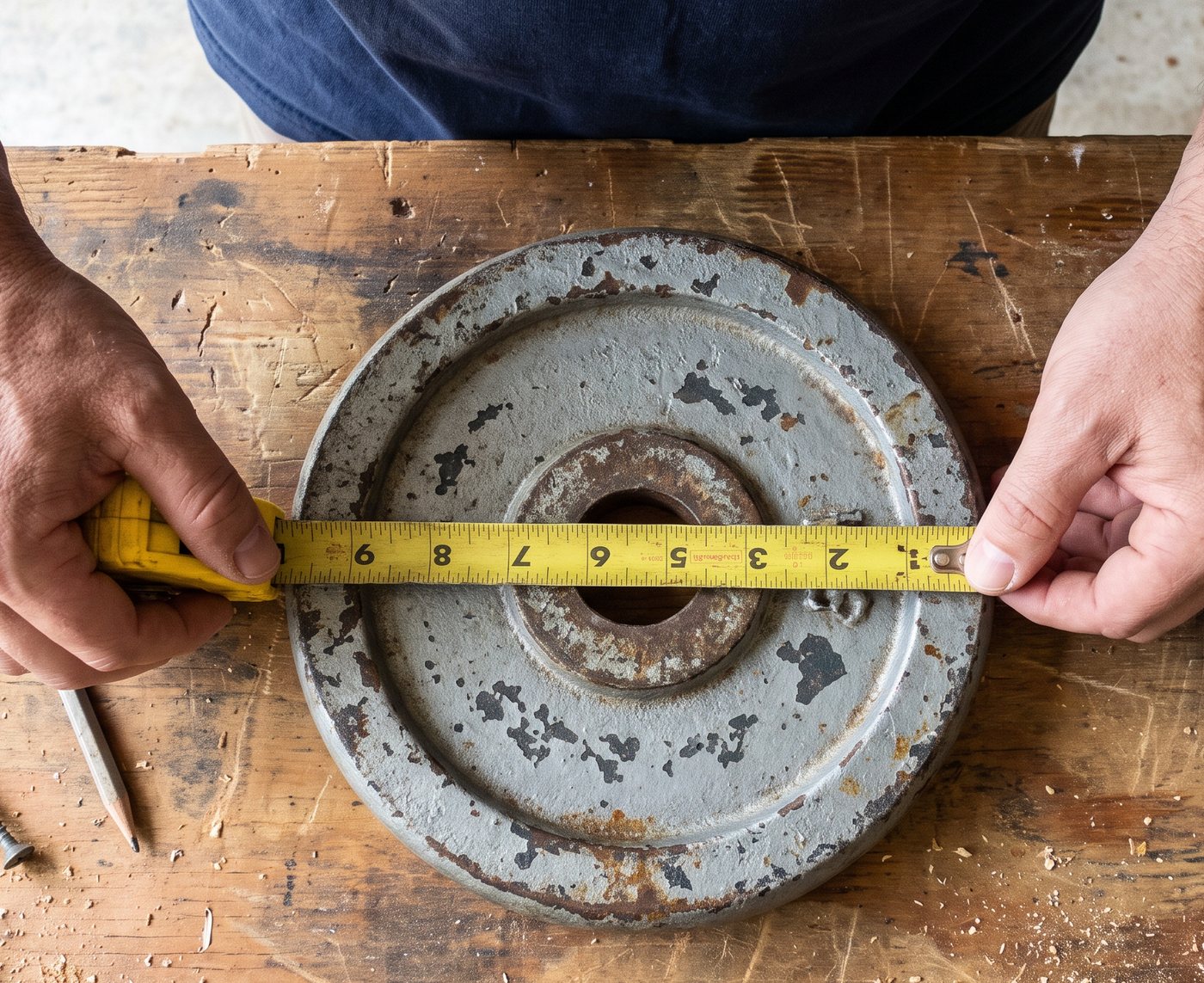
Standard plates are sold as one inch, but that is a name, not a promise. The hole varies by brand and by decade. Whatever you slide them onto has to be thinner than the tightest hole in your stack, so we measured every plate before doing anything else. A caliper is the easy way. A ruler across the hole gets you close.
-
Nothing can stick out past the plates
The end has to stop flat against the outside plate. That is what lets a dumbbell sit on your thighs while you get into a press, and keeps it out of your chest at the bottom of a bench press. The old spinlock bars fail this before you load a single plate.
-
The lock has to stay tight and still undo by hand
A collar that walks loose mid set is how this set ended up on the shelf. A lock that needs a wrench to undo is its own problem in a garage where the wrench is never where you left it.
-
It has to handle thin plates and fat ones
Dad's 2.5s are thin, and one thin plate on a long post rattles. His 25s are fat, and a short post runs out of room before it runs out of strength. Whatever holds them has to deal with both.
The spinlock handles pass the first check and fail the next two. The dial sets and the rack never get tested, because they cannot use the plates at all.
The $49 Handles That Passed All Four
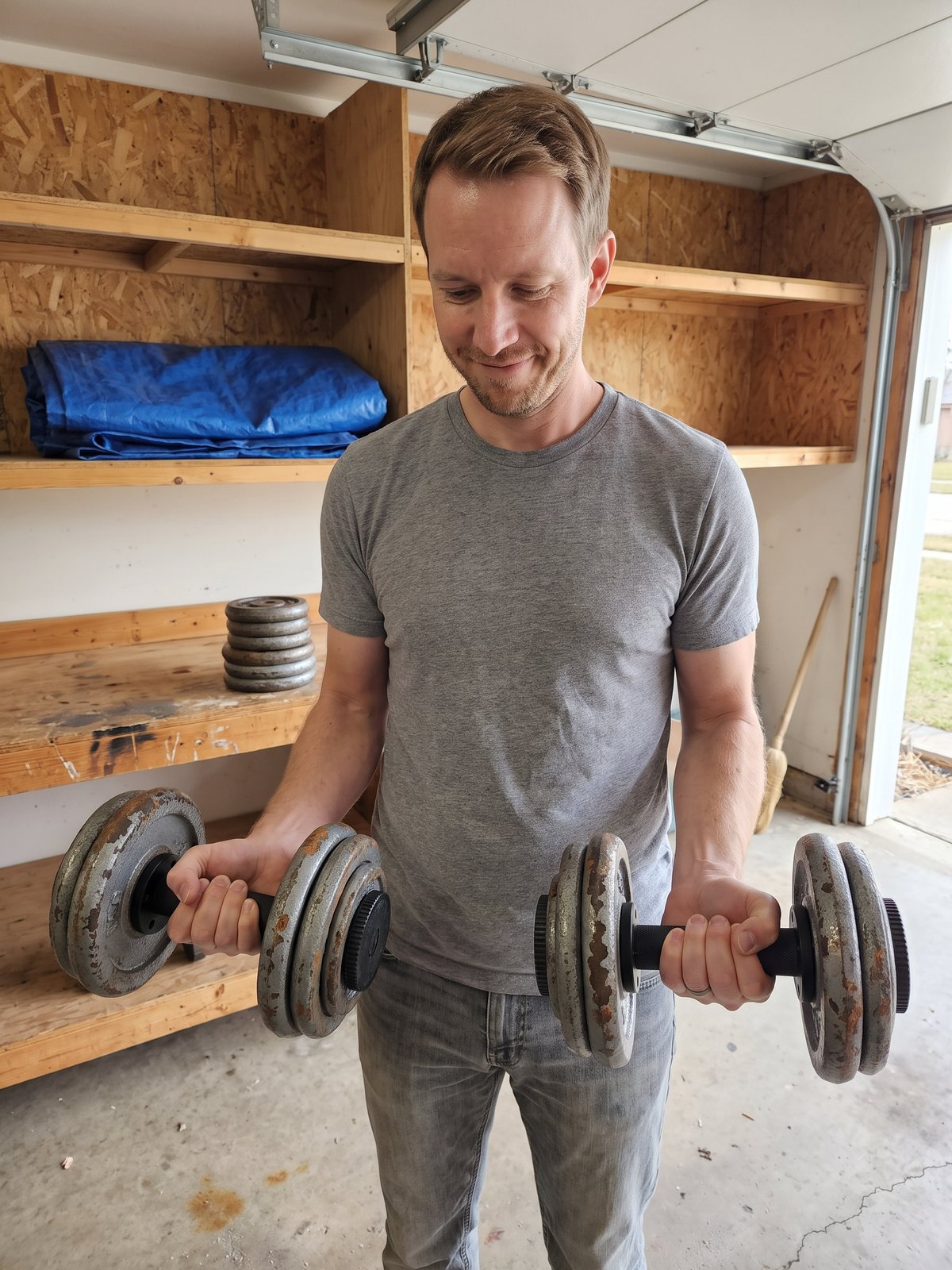
The handle I had in mind was the Kensui AdaptaBELL PRO. I have had a pair in my own garage for a while, so the flat end and the lock were not the question. Dad's plates were. So I bought him a pair and we tested it on every plate he owned.
It is a weird looking thing the first time you hold it. There is no bar at all, just a short knurled grip with a threaded post at each end. Plates slide over the post, and the post screws into the grip until its flat end clamps them. Kensui lists it for standard plates with a 1.1 inch hole (28 mm), and for Olympic plates with $9 centering adapters, four to a pack. It holds 70 pounds in each hand, and the pair costs $49.
- Took every plate Dad owned but two, with nothing sticking out past the ends.
- 70 pounds in each hand, twice what his plates can put on a pair.
- $49 a pair, $500 less than the set in his cart.
Olympic or thick plates? The $99 bundle adds 16 centering adapters and a 4 pack of longer posts.
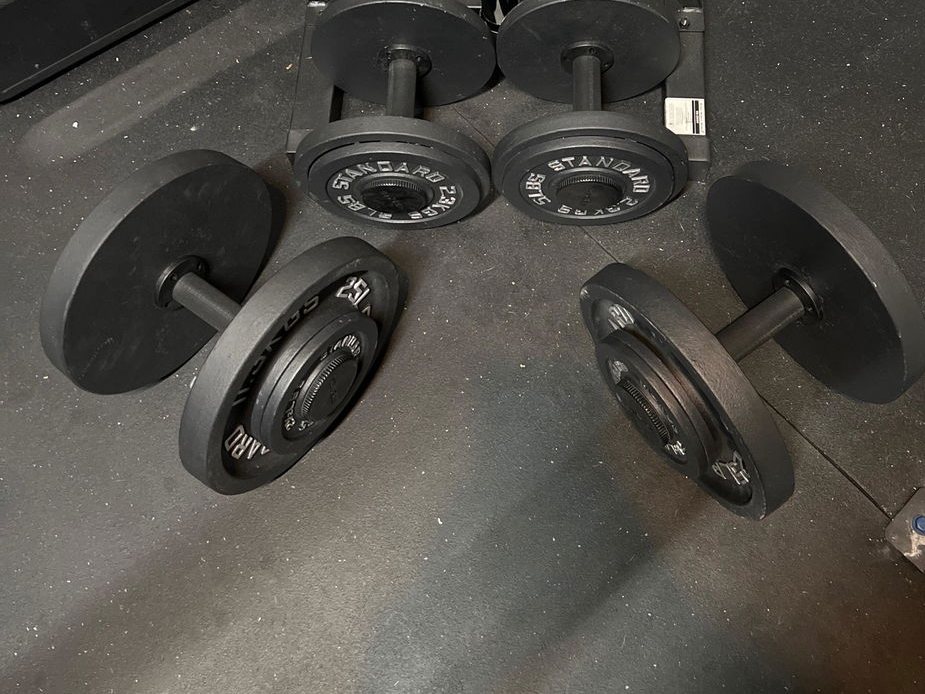
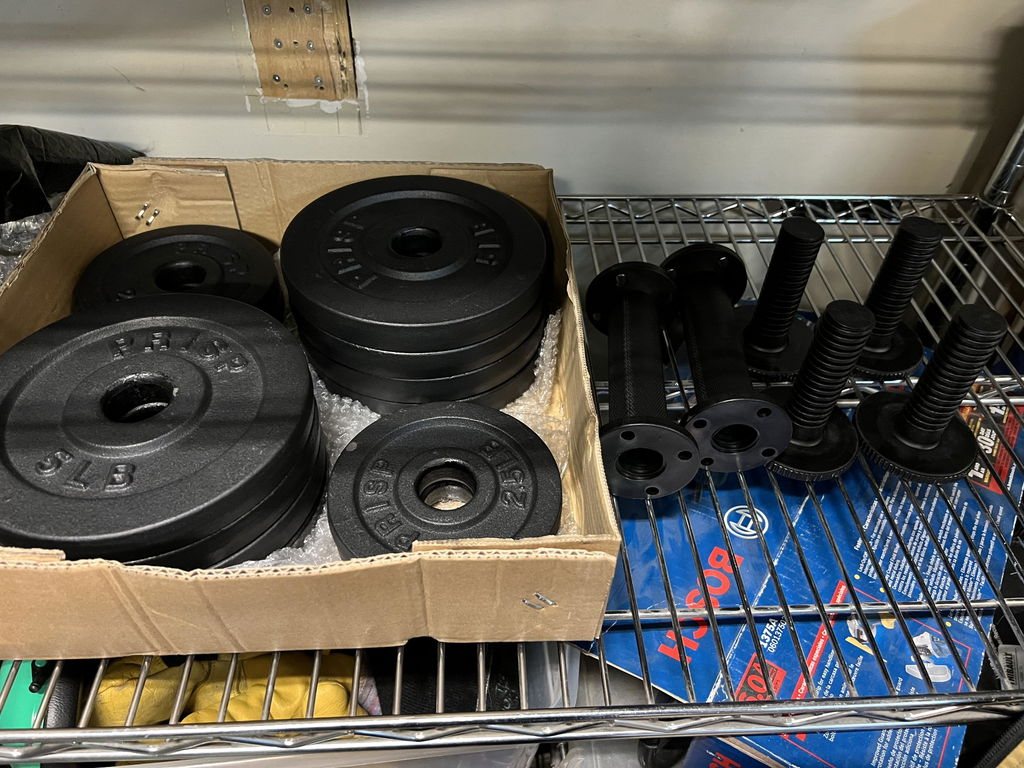
What Happened When We Loaded Dad's Plates
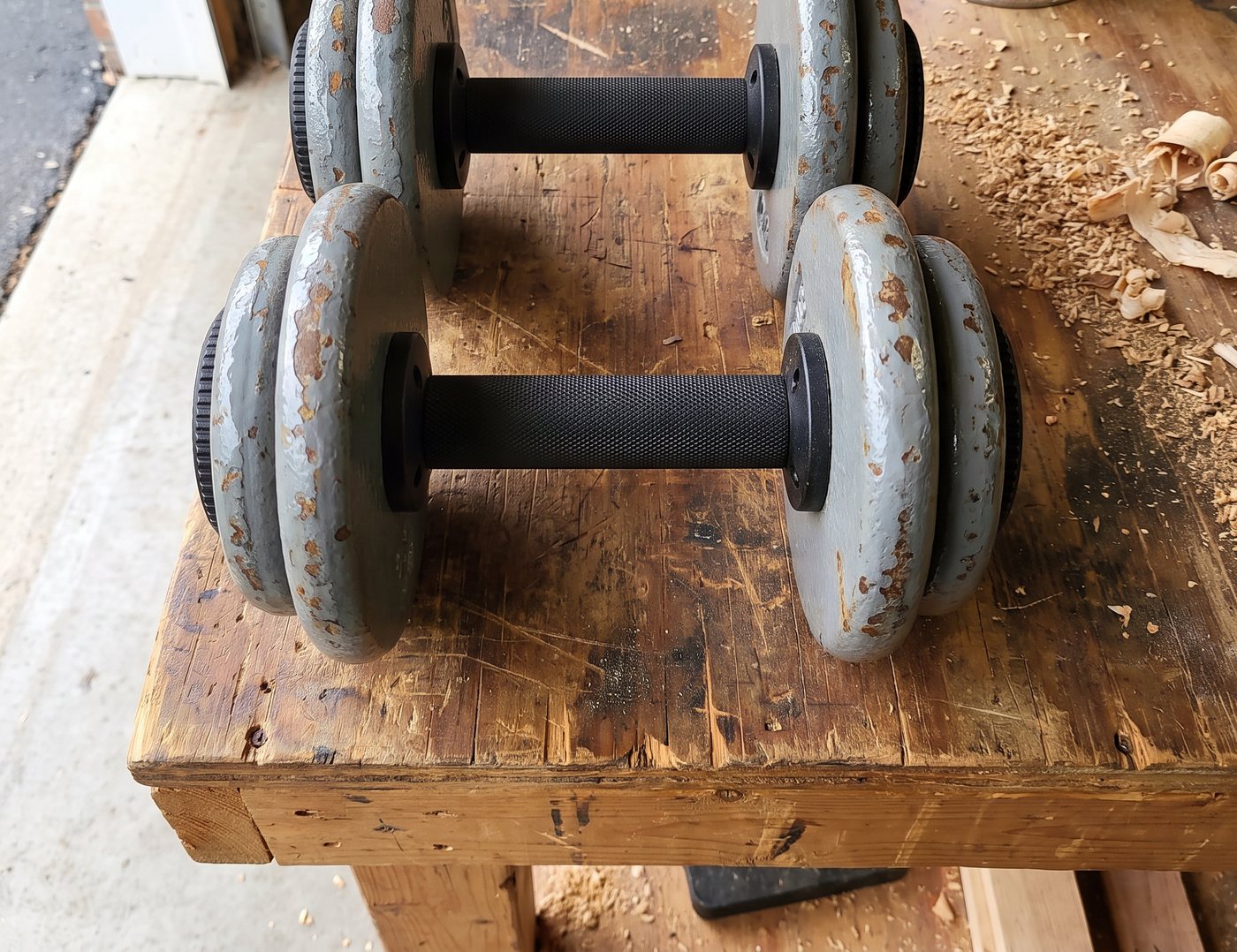
The 25s and the 10s went on without a fight. The end sat flat against the outer plate, and when I rested a loaded pair on my knees, nothing dug in.
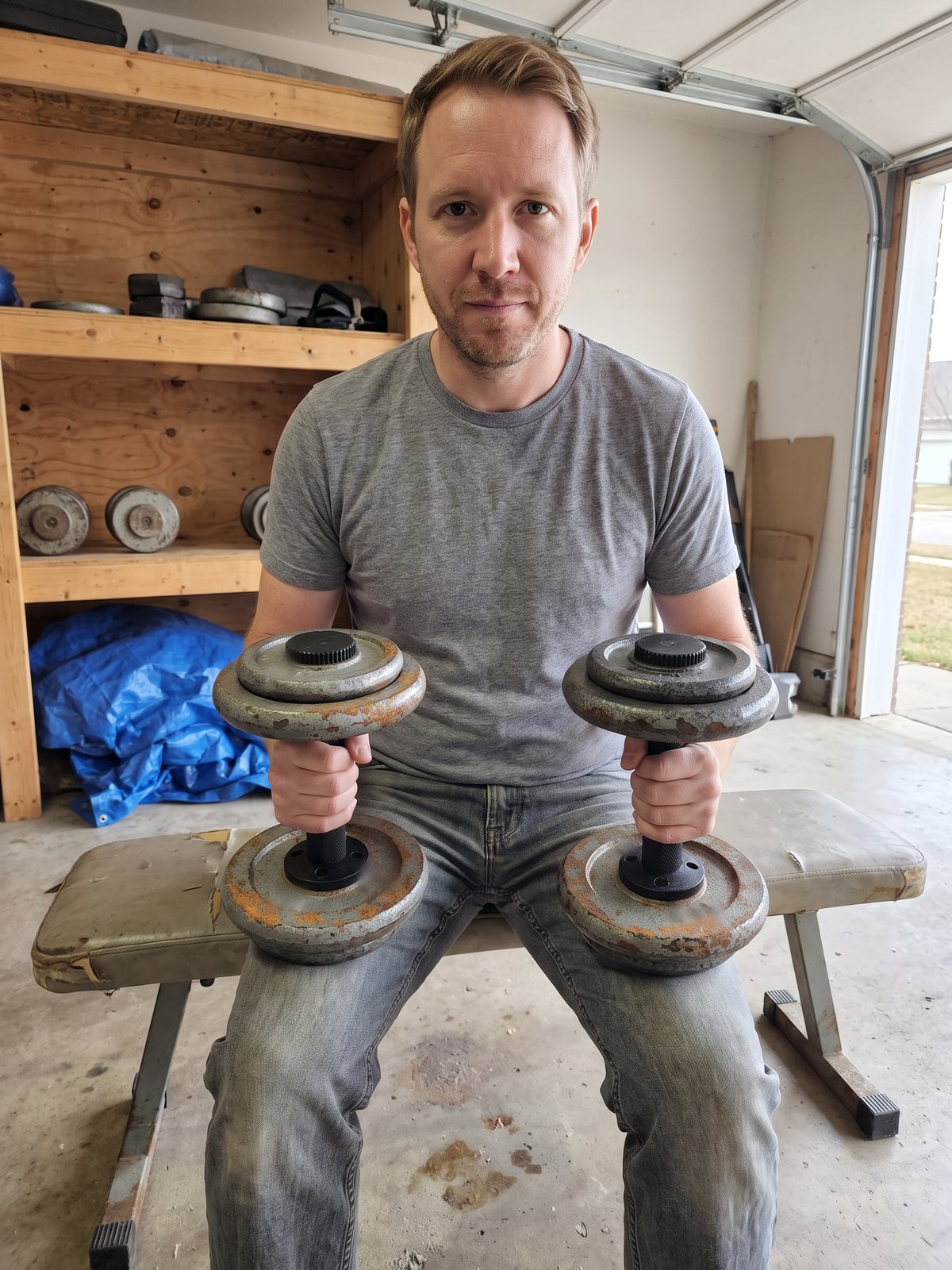
Two of his six 5s would not start onto the post. They are a different brand, bought later, and the caliper put their holes a hair under 1.1 inches. We did not force them. They went back on the old bar, which takes anything with a one inch hole. The other four went on the handles.
Dad is not unusual. I went through every AdaptaBELL review on Kensui's product page, and 26 owners say some or all of their standard plates would not go on without force, filing or grinding.
One 2.5 alone on each end rattled, because the post had room to spare. A steel washer behind it fixed that, the trick one owner describes in his review.
That was the whole test. With his plates, one pair of handles now makes every dumbbell pair from about 5 to 35 pounds a hand in 5 pound steps, plus a single 50 pounder from the two 25s.
Fat plates hit the opposite limit. The PRO has 3.3 inches of post per side, and one owner with rubber coated plates could fit only two 5 kg plates a side. Kensui sells longer posts for exactly this.
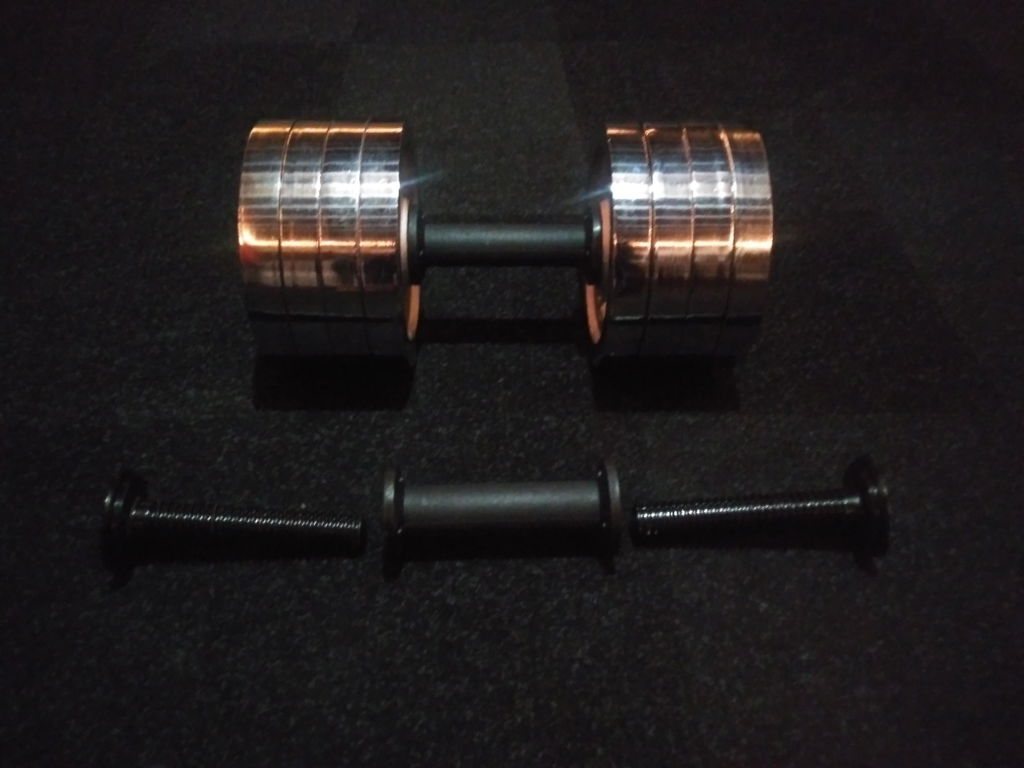
"Using the AdaptaBell was perfect because I had a lot of plates laying around, so I was able to have a great adjustable pair with ease."
Joseph A., 5 stars
"I am using it with cap standard plates and it comfortably allows for 3 plates or 60 lbs. ... Not as quick to change as I hoped."
Brian N., 4 stars
"The thread size is a little too large to fit 1 inch plates, I am having to grind out the center of my weights slightly to use most of them. ... But well worth the effort."
John M., 4 stars
The honest cost is time. Every change means unscrewing an end and swapping plates, slower than a dial every time, so Dad plans each session around two or three weights.
Hand tight is plenty. Several owners overtightened theirs and needed pliers or a wrench to undo them, because the round end gives you nothing to grab.
The ceiling is 70 pounds a hand. If you press heavier than that, this is the wrong handle, and the heavier MAX was sold out when I checked.
$49 a pair · 4.51 from 626 reviews · 100 days to return
| AdaptaBELL PRO | Spinlock handles | PowerBlock Pro 50 | Bowflex 552 | Hex rack, 5 to 50 | |
|---|---|---|---|---|---|
| Price | $49 a pair | $32.99 a pair | $549 | $399 sale, $479 list | $699.99 |
| Uses your old plates | Yes. 1.1 inch holes, Olympic with $9 adapters | Yes, any one inch hole | No | No | No |
| Most per hand | 70 lb | 100 lb | 50 lb | 52.5 lb | 50 lb |
| Bare bar past the plates | No, flat end | Yes, threads | No | No | No |
| Changing weight | Unscrew, swap plates | Unscrew collar, swap plates | Move a pin | Turn a dial | Grab the next pair |
| Learn More |
Before You Order, Measure Your Plates
- Will my plates fit?
- Measure the hole. At 1.1 inches (28 mm) or wider, the plate goes on. A hole of exactly one inch will not, and no twisting changes that. Right at 1.1 is snug, and one owner says aim for about 30 mm for an easy fit.
- What about Olympic plates?
- With centering adapters, $9 for four or $17 for eight. Each centers up to two plates, so owners say buy eight.
- Is the PRO really plastic?
- Reinforced polymer, rated for 140 pounds across the pair. A few owners report a cracked end, two after a drop, so set them down.
$49 against the $549 in Dad's cart is $500 he kept. Kensui gives you 100 days to send the handles back for a full refund, no questions asked. That covers the one real risk here, a plate that will not go on.
Prices checked on each seller's site on September 27, 2026. Fit and loading details from the AdaptaBELL product page, FAQ and reviews that day.
Dad's Plates Are Off The Shelf
The pair sits loaded on his bench now, with the rest of the stack beside it. If your garage has a stack like his, measure one hole tonight.
Get the AdaptaBELL$49 a pair · 4.51 from 626 reviews · 100 days to return
