The Forgotten Strength Tool That Builds Grip, Rotation, and Resilient Shoulders
Your muscles can be strong while your movement system stays weak. Here is the simple tool that trains the difference.


Your Muscles Are Strong. Your Movement System Might Not Be.
You can bench a good number. You can pull a heavy row. But hold a weight out away from your hand and try to control it, and something feels off.
Your grip starts to burn. Your shoulder works overtime. Your trunk fights to keep you square. The weight is light, yet the task is hard.
That gap has a cause. Most training builds force in straight lines. Real movement happens in rotation, at odd angles, and under loads held out at the end of a long lever. This is the strength quality most lifters never train.
Here is the tool that trains it, and the simple physics that makes it work.
Why Modern Training Builds Strong Muscles but Weak Movement
Look at most programs and you see the same shapes. Bench press. Rows. Pull-ups. Overhead press. Every one of them moves in a straight line.
Straight lines are great for adding weight. They are not great for teaching your body to control a load that wants to twist, tip, or pull you off balance. The bar travels one path, and your stabilizers get to ride along for free.
Machines push this even further. A machine holds the path for you. It takes away the wobble, which means it takes away the work your stabilizers should be doing. You get strong in one fixed groove and learn almost nothing about the angles around it.
So you end up with powerful prime movers and quiet stabilizers. Big numbers on the main lifts, and a shoulder that feels stiff the moment you step outside the groove. Strength without control is only half the job.
The Forgotten Tool That Trains Strength Differently
There is an old class of tool built for exactly this problem. Weighted clubs.
Indian clubs, clubbells, and steel maces all share one trait. The weight sits out at the end of a handle, far from your grip. That one design choice changes how the whole load feels in your hand.
This is not mystic warrior training. It is plain physics you can measure. When the weight sits away from your hand, your grip, forearm, shoulder, and trunk all have to manage a much larger rotational pull. Push the load further out and every one of them works harder to keep it under control.
Coaches reach for clubs to build grip endurance, shoulder control, and rotational strength that barbells skip. The tool is old. The reason it works is not a mystery.

Why a Long Lever Feels So Different
Pick up a 10-pound dumbbell and hold it out in front of you. Now picture that same 10 pounds out at the end of a two-foot handle. The second one feels far heavier, even though the weight on the scale has not changed.
That feeling has a name. Torque.
Torque is force multiplied by the length of the lever arm.[1] Keep the weight the same and make the lever longer, and the torque your joints have to control climbs fast. The number on the plate is identical. The demand on your body is not.
Your rotator cuff feels this first. Those four small muscles act as the dynamic stabilizers of the shoulder, holding the ball centered in the socket while your arm moves.[2] A long lever asks them to do that job under much more rotational load, which is the exact stimulus a stiff, under-trained shoulder is missing.
Your grip feels it next. Holding a long lever steady is a grip-endurance task, not a single max effort. Grip also happens to be one of the simplest windows into whole-body strength, and lower grip strength tracks with worse long-term health across a study of nearly 140,000 adults.[3]

Same Weight, Different Torque
The weight sits right at your hand. Short lever, little rotational demand.
Same weight, held farther out. Long lever, far more for your grip and shoulder to control.
See the Tool That Puts the Load Out on a Long Lever
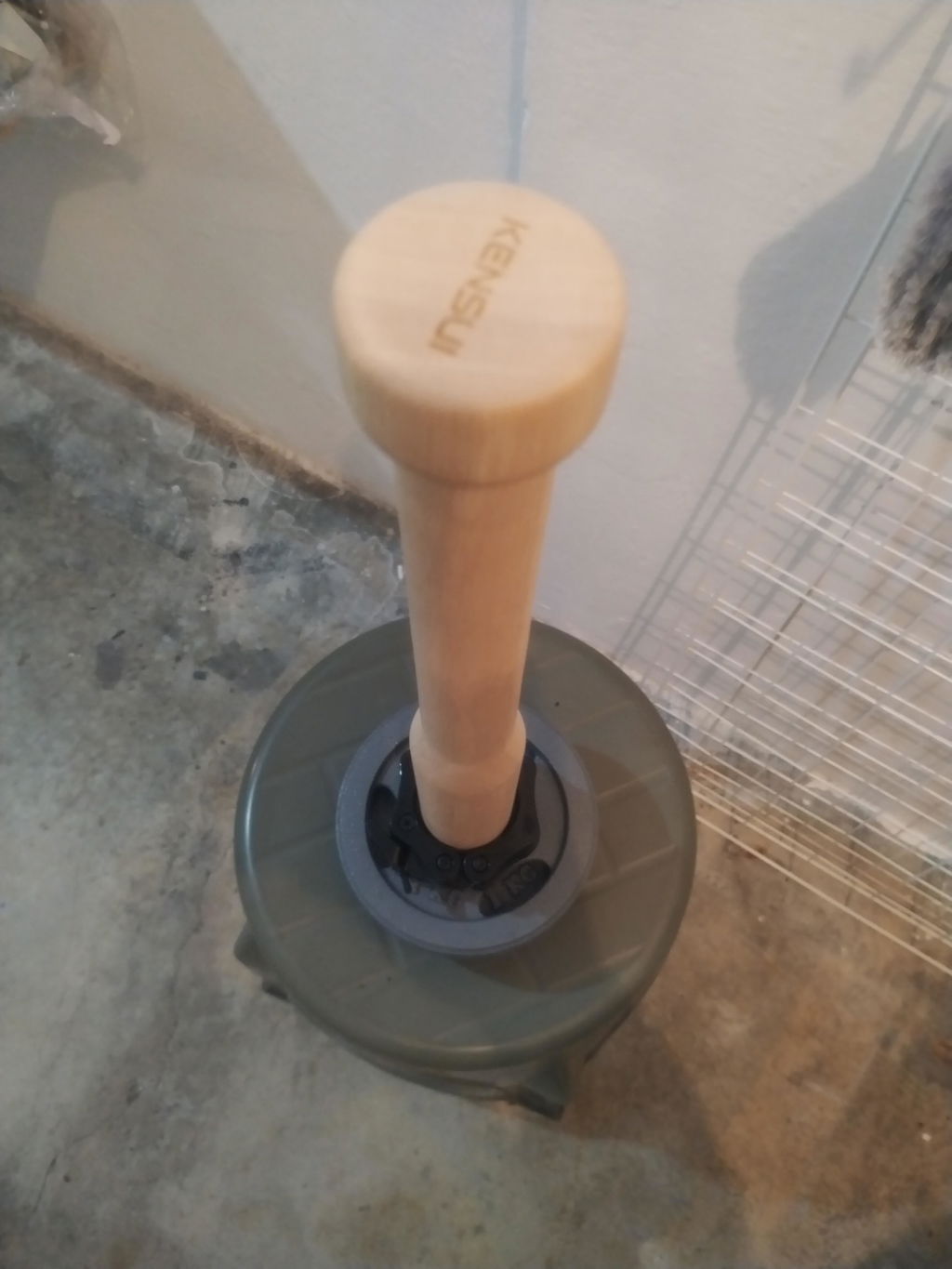
The Kensui EZ-CLUB V2 is a plate-loaded club. Start light to learn the movement, then add plates as your grip and shoulders catch up.
Why Most People Never Stick With Club Training
If clubs are this useful, why does almost nobody own one? The honest answer is the way they have always been sold. Traditional clubs are a pain to progress.
A fixed club is one weight and nothing more. Outgrow it, and you buy the next size up. Then the size after that. Before long you have a row of clubs on the floor, each one good for only a narrow slice of work.
That gets expensive, and it eats space fast. Few people want to buy five clubs and store them in a small home gym. So most try a club once, run into the ceiling of that single weight, and quietly move on.
The tool was never the problem. The format was.
The Adjustable Solution: Meet the Kensui EZ-CLUB V2
The fix is simple. Build one club that changes weight.
The Kensui EZ-CLUB V2 is a plate-loaded club. Instead of a shelf of fixed clubs, you load the standard 2-inch plates you already own. Go light for mobility and rehab. Go heavy for rotational power and grip. One handle covers the whole range.

Plate-loaded
Takes standard 2-inch Olympic plates. Light for mobility, heavy for power, all on one handle.
Wood or steel handle
Pick a natural wood handle for grip feel and wrist feedback, or knurled steel for a tougher hold.
Single or pair
Run one club for offset work, or a matched pair for two-hand and flow training.
Band compatible
Anchor a resistance band to the end for extra tension on presses, pulls, and rotations.
Rehab to strength
Start light to rebuild a cranky shoulder, then add plates as you get strong.
Collar included
Comes with a collar that locks your plates in place so the load stays put mid-rep.


Traditional Fixed Clubs vs. the Kensui EZ-CLUB V2
| Category | Traditional Fixed Clubs | Kensui EZ-CLUB V2 |
|---|---|---|
| Cost to Progress | Buy a new club each jump | Add plates you own |
| Storage Space | A row of clubs on the floor | One handle |
| Weight Range | One fixed weight each | Light to heavy on one tool |
| Grab-and-Go Simplicity | Nothing to load | Load plates first |
| Band Work | Not built for it | Band compatible |
| Rehab-to-Strength Scaling | Hard to scale down | Loads light for rehab |
The pattern is clear. A fixed club locks you into one weight and asks you to buy the next one to keep going. The EZ-CLUB loads the plates already in your gym, so a single handle scales from a light rehab warm-up to heavy rotational work.
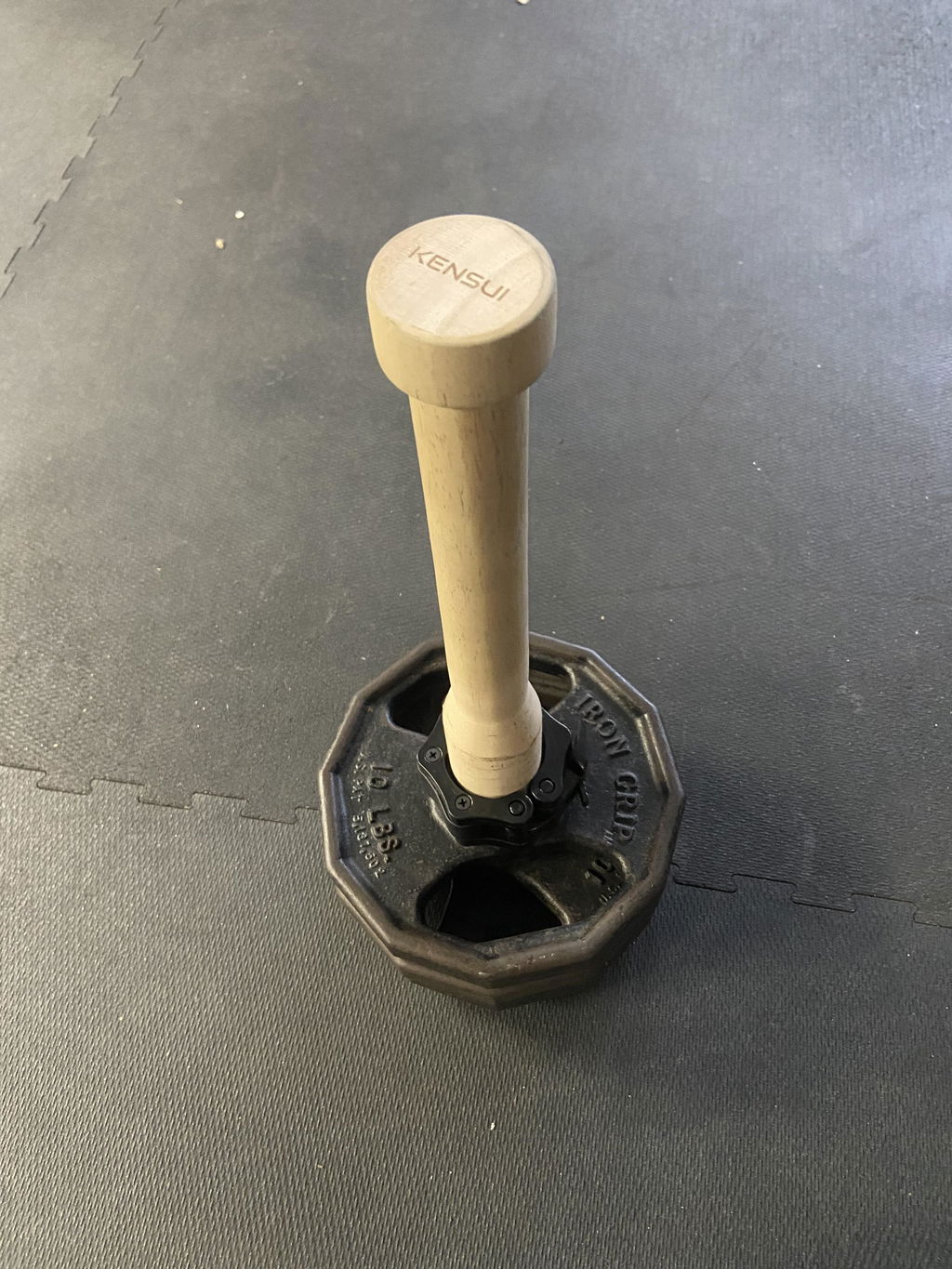
A fixed club still wins on pure simplicity, since there is nothing to load. For most people, the trade of ten seconds of loading for one tool that does it all is an easy call.
Who the EZ-CLUB V2 Is Best For
Club training is not only for athletes. It fits anyone whose shoulders, grip, or rotation get skipped by straight-line lifting.
Desk workers with stiff shoulders
Open up shoulders that lock up after years at a keyboard.
Lifters wanting a new stimulus
Train the rotation and grip your barbell program skips.
Grapplers
Build the wrist and grip control that wins scrambles.
Climbers
Add crush grip and shoulder stability for time on the wall.
Calisthenics athletes
Round out straight-plane pushing and pulling with rotation.
Combat sports athletes
Develop rotational power that shows up in your strikes.

Build Grip, Rotation, and Resilient Shoulders on One Handle
Build rotational strength, grip, and resilient shoulders without buying an entire rack of clubs.

- Plate-loaded with standard 2-inch plates
- Wood or steel handle
- Train as a single or a pair
- Band compatible
- Scales from rehab to heavy strength
Or keep reading our training science →
Sources
- Hik F, Ackland DC. The moment arms of the muscles spanning the glenohumeral joint: a systematic review. Journal of Anatomy, 2019. Background on how lever arm length sets the torque acting at the shoulder. View study
- Anatomy, Rotator Cuff. StatPearls, NCBI Bookshelf. The supraspinatus, infraspinatus, subscapularis, and teres minor act as the dynamic stabilizers of the glenohumeral joint, compressing the humeral head into the socket during motion. View reference
- Leong DP, Teo KK, Rangarajan S, et al. Prognostic value of grip strength: findings from the Prospective Urban Rural Epidemiology (PURE) study. The Lancet, 2015;386(9990):266-273. Grip strength was a strong predictor of all-cause and cardiovascular mortality across nearly 140,000 adults. View study
