Light Weights Build as Much Muscle as Heavy Ones. There's One Condition. | Science Meets Gym

Science · 7 min read

Light Weights Build as Much Muscle as Heavy Ones. There's One Condition.
A man in a navy t-shirt standing in a bright garage gym, grinding out the last rep of a long set of curls with a small black hex dumbbell, forearm and biceps pumped, face strained, a dumbbell rack out of focus behind him

Twenty-one trials say a set of 30 reps with a light weight builds about as much muscle as a set of 8 with a heavy one, as long as the light set runs almost to failure. The pump you feel on the way there is real. Whether it is the reason is where the trials split.

The Claim

The reel opens on a bodybuilder ripping through high reps with no rest between them. He is chasing the pump, the tight, swollen feeling Arnold Schwarzenegger called the greatest feeling you can get in the gym.[1] The reel's explanation goes like this. Nonstop reps trap blood in the muscle. Waste products pile up. Water gets pulled into the muscle cells and they swell. The cell reads that swelling as a threat to its structure and answers by building more protein. Mechanical tension is still the main driver of growth, the reel says, but the pump is a powerful second trigger. That is why light weights for high reps can still build serious muscle, as long as you take the set close to failure.

You know the feeling. Twenty reps into a set of curls, the muscle is hot, tight and a size bigger than it was five minutes ago. An hour later it is gone. Was anything in that hour growth, or was it just plumbing?
A man in a navy t-shirt standing in a garage gym after a set, one hand on his hip and a small black hex dumbbell in the other, looking down at his flushed, pumped forearm with a tired half-smile, a dumbbell rack behind him

There are two claims here. One: light weights taken near failure build as much muscle as heavy ones. Two: the pump is why. The first is among the best-tested ideas in training science. The second is still being worked out, one link at a time.

What the Research Actually Found

Start with the pump itself, because it can be measured. In 2022, 22 untrained men did three sets of eight leg extensions at 80 percent of their max. An ultrasound taken minutes later showed the front of the thigh 8.3 percent thicker than before the session. Six weeks of the same workout, three times a week, grew the thigh 2.9 percent for good.[2] The men who swelled most on day one tended to grow most by week six. That is a hint, not proof, since everyone did the same workout.
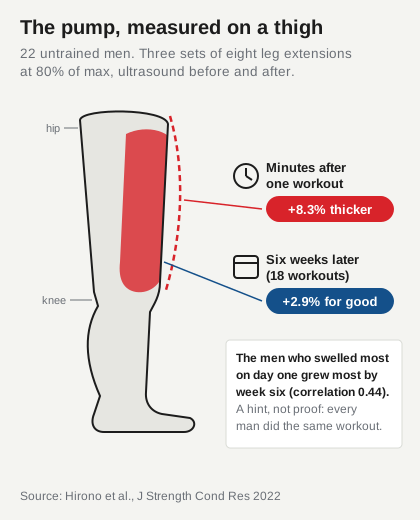
Infographic of a thigh outline from the 2022 Kyoto trial: a dashed outer line shows the thigh 8.3 percent thicker minutes after one leg-extension workout, a solid inner line shows it 2.9 percent thicker after six weeks, and a note says the men who swelled most grew most

Where does the fluid come from? In 1985, six men did one-legged knee extensions to exhaustion with a needle in the thigh. The muscle's water content rose as the work got harder, and in the all-out bout most of the extra water ended up inside the fibers, not between them.[3] Lactate and other by-products pile up faster than the blood can clear them, and water follows them into the cell. The contracting muscle also squeezes its own veins, so blood arrives faster than it leaves. That part of the reel is textbook physiology.[4]

The next step is the leap. In 1993 a group in Freiburg argued in The Lancet that a cell's water content works as a switch for protein turnover. Swollen cells build protein and break less of it down. Shrunken cells do the opposite.[5] Most of that work was done on liver cells. In 10 healthy men, a dilute drip that made the body's cells swell cut whole-body protein breakdown.[6] In rat muscle cells in a dish, swelling raised the uptake of the amino acid glutamine by 71 percent, through the same anchor structures that sense mechanical load.[7] That is the chain behind the line "the cell reads swelling as a threat and reinforces itself". Each link has been shown somewhere. Nobody has shown the whole chain running in a lifter's muscle after a set of curls.
Side view of a man in a navy t-shirt seated on a leg extension machine in a gym, legs almost straight against the roller pad, thighs tight, the pin set high on the weight stack

Now the half that is not in doubt. In 2012, researchers at McMaster University had 18 men train one leg at 30 percent of their max and the other at 80 percent for 10 weeks, every set to failure. On MRI, the light leg grew 6.8 percent and the heavy leg 7.2 percent, no real difference.[8] Three years later the same idea was tested on experienced lifters: 18 men, three days a week for eight weeks, one group at 25 to 35 reps a set, the other at 8 to 12. Their biceps grew 8.6 percent on the light program and 5.3 percent on the heavy one. Triceps: 5.2 against 6.0. Quads: 9.5 against 9.3. None of those gaps was significant. Squat strength was a different story, up 19.6 percent for the heavy group and 8.8 percent for the light one.[9] A 2017 meta-analysis pooled 21 such trials, all with sets taken to failure. Muscle growth was the same across loads. Heavy loads won on max strength.[10]
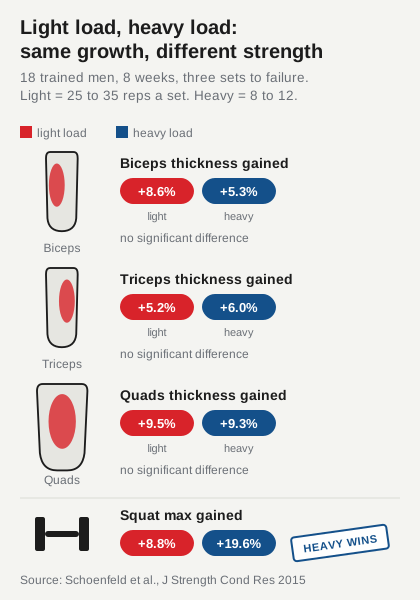
Infographic of a body outline with paired growth figures from the 2015 trial in trained men, light load against heavy load: biceps 8.6 against 5.3 percent, triceps 5.2 against 6.0, quads 9.5 against 9.3, and a strength footnote that the squat max rose 8.8 percent on the light program against 19.6 on the heavy one

Then the condition. In 2022, a team in São Paulo put 25 untrained men through eight weeks of leg extensions, each leg on a different protocol with total work matched. At 80 percent of max, the quads grew 8.1 percent when sets went to failure and 7.7 percent when they stopped short. At 30 percent, sets to failure grew the quads 7.8 percent. Sets that stopped short grew them 2.8 percent, which did not reach significance.[11] Heavy sets grow whether or not you finish them. Light sets only grow if you take them to the wall. A 2024 analysis of the whole literature found the same slope: the closer to failure, the more growth, while strength gains did not care.[12]
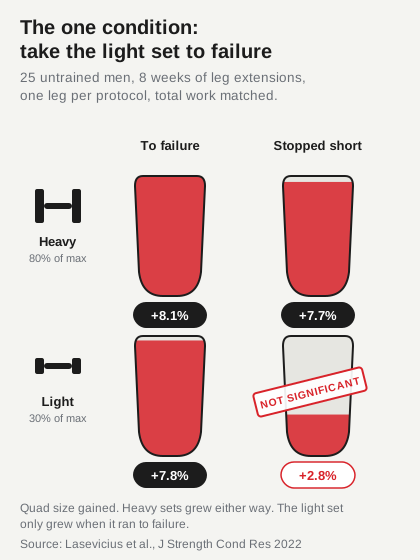
Infographic of four thigh outlines from the 2022 Sao Paulo trial, filled in proportion to growth: heavy load to failure 8.1 percent, heavy load stopped short 7.7 percent, light load to failure 7.8 percent, light load stopped short 2.8 percent with a stamp reading not significant

The reason ties the two halves together. Your nervous system recruits small, tireless fibers first and saves the big, fast-growing ones for when it needs them. With a heavy bar it needs them on rep one. With a light dumbbell it does not call them in until the small fibers fade near the end of the set. The last few reps are when the whole muscle is finally working. They are also when the pump peaks. The two arrive together, which is why they are so hard to tell apart in a study.[13]

What It Looks Like in Practice

Four rules fall out of those trials.

  1. Pick the load by your joints, not by a theory. Anything from about 30 to 80 percent of your max builds the same muscle. That is a set that fails somewhere between 8 and 30 reps. Sore elbows do fine on the light end. Impatient people do fine on the heavy end.
  2. On a light set, the last reps are the set. Stop a 30-rep set with five reps in the tank and you keep the burn but lose most of the growth: 2.8 percent against 7.8 in the São Paulo trial.[11] If you are not sure you got close, you did not.
  3. Rest long enough to do the next set properly. In 21 trained men, three minutes between sets grew the thigh more than one minute did, because the short-rest group could not keep its reps up.[14] The pump is not worth a set of junk reps.
  4. Keep some heavy sets if you care about strength. In the 2022 trial the heavy legs gained about 34 percent on their max and the light legs about 17.[11] Growth is load-blind. Strength is not.
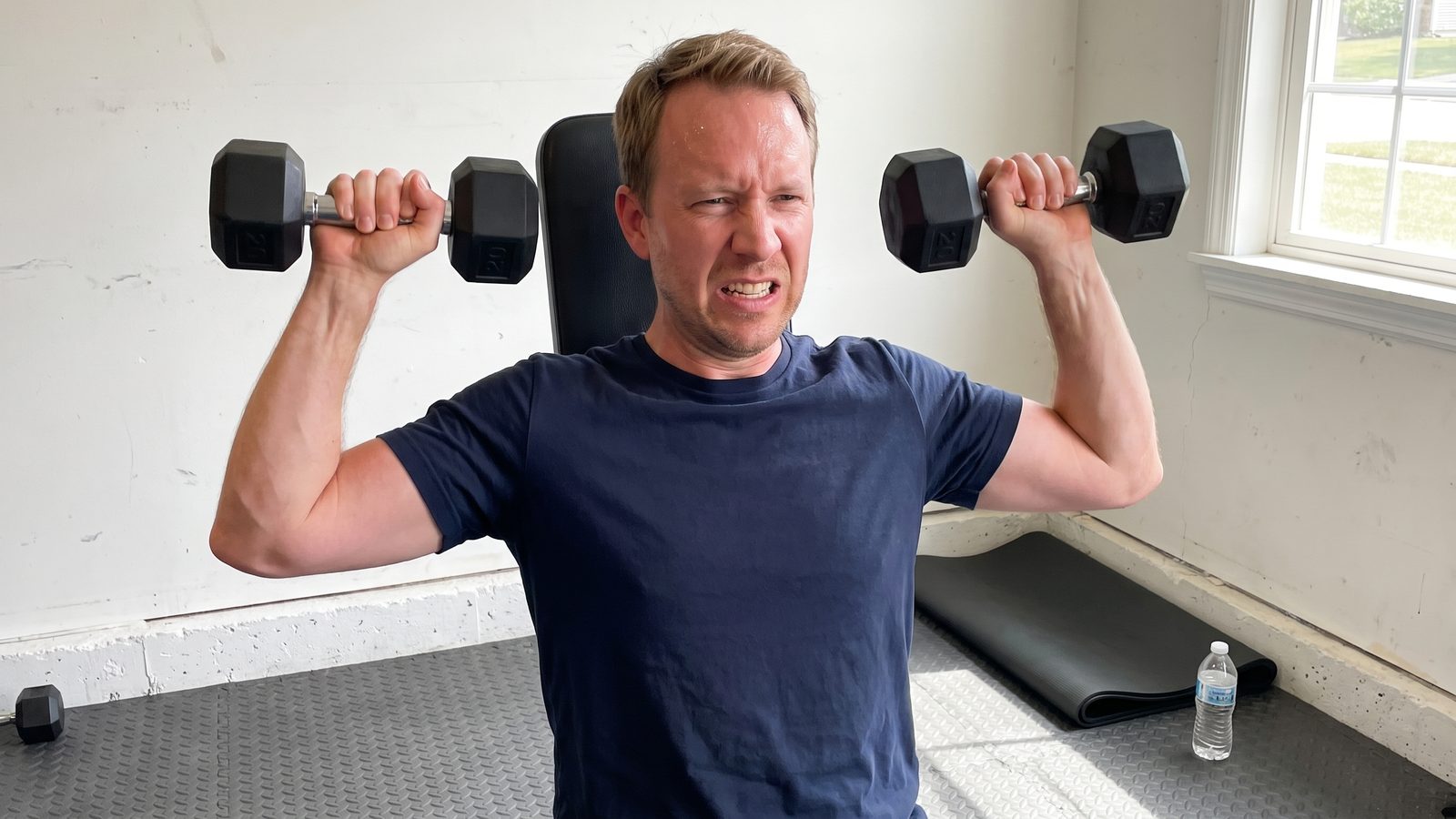
A man in a navy t-shirt seated on an upright bench in a garage gym, pressing two small black hex dumbbells at ear height on the last rep of a set, face grimacing, a rolled mat and water bottle on the floor behind him
Read more Your muscles are far stronger on the way down than the way up, and most programs never train that half.

References

  1. Butler G, Fiore R, directors. Pumping Iron. Cinema 5; 1977. Schwarzenegger's line in the film is "the greatest feeling you can get in the gym is the pump".
  2. Hirono T, Ikezoe T, Taniguchi M, et al. Relationship between muscle swelling and hypertrophy induced by resistance training. J Strength Cond Res. 2022;36(2):359-364. doi:10.1519/JSC.0000000000003478
  3. Sjøgaard G, Adams RP, Saltin B. Water and ion shifts in skeletal muscle of humans with intense dynamic knee extension. Am J Physiol. 1985;248(2 Pt 2):R190-R196. doi:10.1152/ajpregu.1985.248.2.R190
  4. Schoenfeld BJ. Potential mechanisms for a role of metabolic stress in hypertrophic adaptations to resistance training. Sports Med. 2013;43(3):179-194. doi:10.1007/s40279-013-0017-1
  5. Häussinger D, Roth E, Lang F, Gerok W. Cellular hydration state: an important determinant of protein catabolism in health and disease. Lancet. 1993;341(8856):1330-1332. doi:10.1016/0140-6736(93)90828-5
  6. Berneis K, Ninnis R, Häussinger D, Keller U. Effects of hyper- and hypoosmolality on whole body protein and glucose kinetics in humans. Am J Physiol. 1999;276(1):E188-E195. doi:10.1152/ajpendo.1999.276.1.E188
  7. Low SY, Taylor PM. Integrin and cytoskeletal involvement in signalling cell volume changes to glutamine transport in rat skeletal muscle. J Physiol. 1998;512(Pt 2):481-485. doi:10.1111/j.1469-7793.1998.481be.x
  8. Mitchell CJ, Churchward-Venne TA, West DW, et al. Resistance exercise load does not determine training-mediated hypertrophic gains in young men. J Appl Physiol. 2012;113(1):71-77. doi:10.1152/japplphysiol.00307.2012
  9. Schoenfeld BJ, Peterson MD, Ogborn D, Contreras B, Sonmez GT. Effects of low- vs. high-load resistance training on muscle strength and hypertrophy in well-trained men. J Strength Cond Res. 2015;29(10):2954-2963. doi:10.1519/JSC.0000000000000958
  10. Schoenfeld BJ, Grgic J, Ogborn D, Krieger JW. Strength and hypertrophy adaptations between low- vs. high-load resistance training: a systematic review and meta-analysis. J Strength Cond Res. 2017;31(12):3508-3523. doi:10.1519/JSC.0000000000002200
  11. Lasevicius T, Schoenfeld BJ, Silva-Batista C, et al. Muscle failure promotes greater muscle hypertrophy in low-load but not in high-load resistance training. J Strength Cond Res. 2022;36(2):346-351. doi:10.1519/JSC.0000000000003454
  12. Robinson ZP, Pelland JC, Remmert JF, et al. Exploring the dose-response relationship between estimated resistance training proximity to failure, strength gain, and muscle hypertrophy: a series of meta-regressions. Sports Med. 2024;54(9):2209-2231. doi:10.1007/s40279-024-02069-2
  13. Dankel SJ, Mattocks KT, Jessee MB, Buckner SL, Mouser JG, Loenneke JP. Do metabolites that are produced during resistance exercise enhance muscle hypertrophy? Eur J Appl Physiol. 2017;117(11):2125-2135. doi:10.1007/s00421-017-3690-1
  14. Schoenfeld BJ, Pope ZK, Benik FM, et al. Longer interset rest periods enhance muscle strength and hypertrophy in resistance-trained men. J Strength Cond Res. 2016;30(7):1805-1812. doi:10.1519/JSC.0000000000001272
  15. Goto K, Ishii N, Kizuka T, Takamatsu K. The impact of metabolic stress on hormonal responses and muscular adaptations. Med Sci Sports Exerc. 2005;37(6):955-963. PMID 15947720
  16. Dankel SJ, Buckner SL, Jessee MB, et al. Post-exercise blood flow restriction attenuates muscle hypertrophy. Eur J Appl Physiol. 2016;116(10):1955-1963. doi:10.1007/s00421-016-3447-2
  17. Wackerhage H, Schoenfeld BJ, Hamilton DL, Lehti M, Hulmi JJ. Stimuli and sensors that initiate skeletal muscle hypertrophy following resistance exercise. J Appl Physiol. 2019;126(1):30-43. doi:10.1152/japplphysiol.00685.2018
  18. Bjørnsen T, Wernbom M, Kirketeig A, et al. Type 1 muscle fiber hypertrophy after blood flow-restricted training in powerlifters. Med Sci Sports Exerc. 2019;51(2):288-298. doi:10.1249/MSS.0000000000001775
  19. Lasevicius T, Ugrinowitsch C, Schoenfeld BJ, et al. Effects of different intensities of resistance training with equated volume load on muscle strength and hypertrophy. Eur J Sport Sci. 2018;18(6):772-780. doi:10.1080/17461391.2018.1450898
Chris Bennett

Chris Bennett

Senior writer

Chris Bennett is a house byline for Science Meets Gym. Gear published under it is bought at retail and trained with before anything gets a verdict, and every claim about training outcomes is checked against the published research first.

Read full bio

Science Meets Gym earns a commission when you buy through some of the links on this page. It never changes which products we recommend or how they score.