
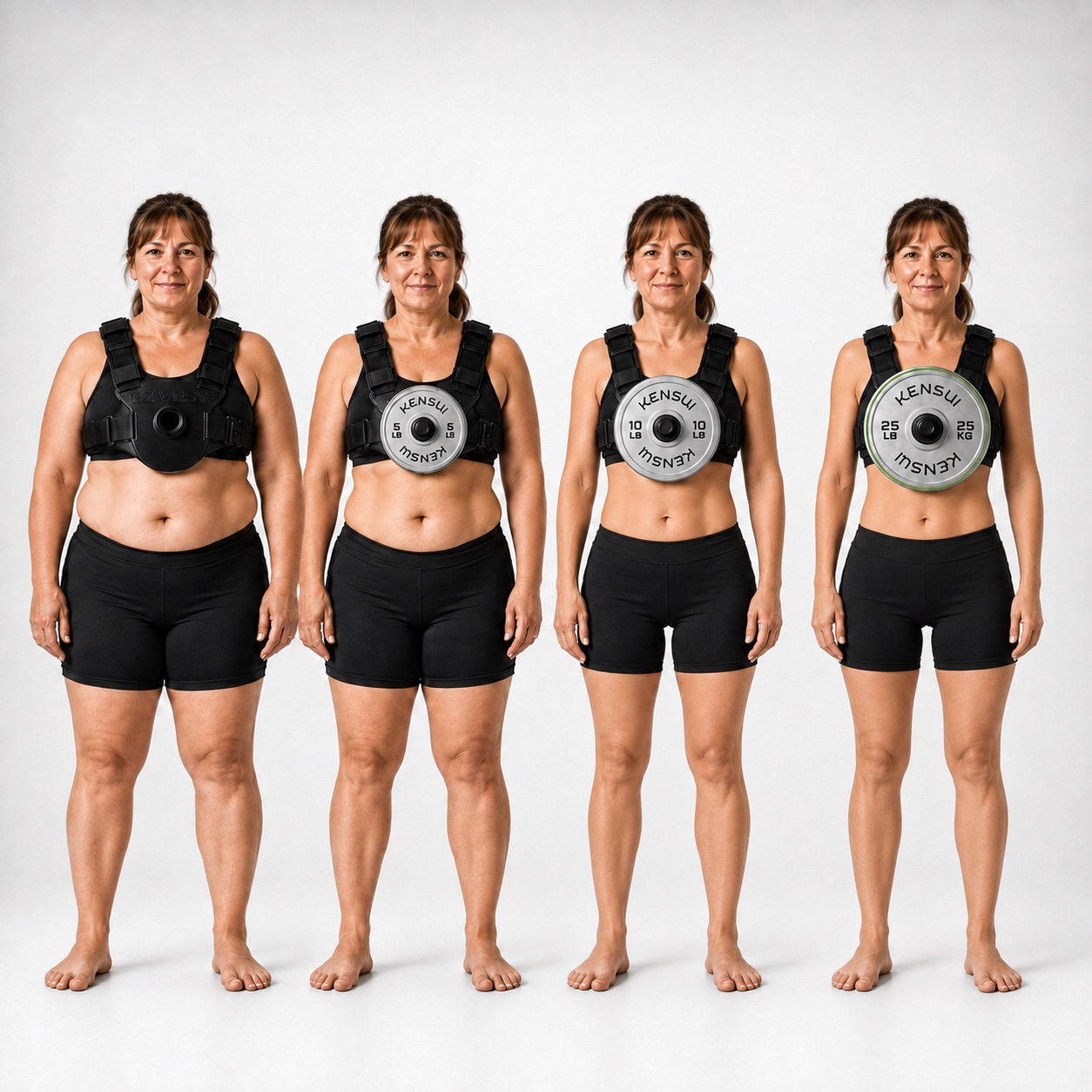
The Scale Inside Your Skeleton
In 2017, a team at the University of Gothenburg placed tiny weighted capsules inside mice. The capsules added 15% to each animal's body weight. Within days, the mice started eating less. Within two weeks, they had lost fat equal to roughly half the added load.
The control group, carrying capsules at just 3% of body weight, lost nothing.
The loaded mice had not exercised more. Their cages were the same size. The only variable was weight pressing down through their skeletons.
The researchers named the mechanism the gravitostat. It starts in your femur and tibia, the two largest weight-bearing bones in your body. These bones contain billions of cells called osteocytes, connected by a web of microscopic projections.
Their known job is sensing mechanical load and telling the body when to build or break down bone. The Gothenburg team discovered they do something else. When the load on these bones rises beyond what the body considers normal, the osteocytes fire a signal to the brain. The brain responds by reducing appetite and increasing fat oxidation.
To prove the sensor was real, they bred mice whose osteocytes could be selectively destroyed. Capsules went in. Nothing happened. Without the sensor cells, loading produced no fat loss at all. (Jansson et al., PNAS, 2018)
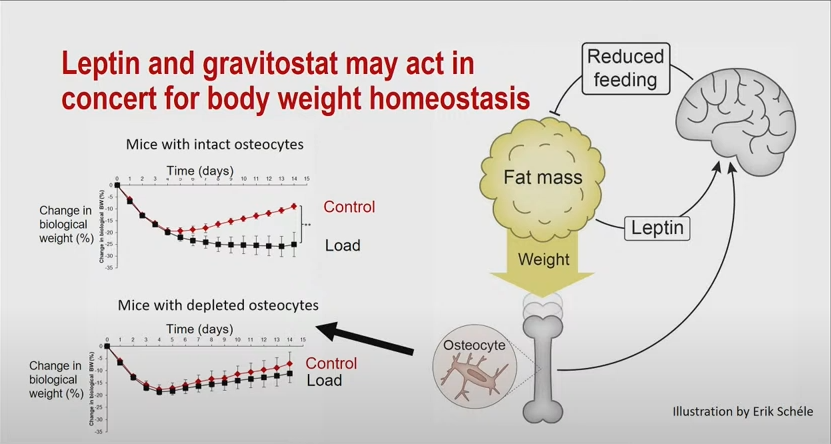
Swipe the chart to read it full size
Read the right half of that diagram first. Fat has weight. That weight presses down through the leg bones, where an osteocyte feels the pressure and sends the reading up to the brain, and the brain answers by turning hunger down. Fat also releases leptin, a hormone reporting to the same brain on its own separate line. The two graphs on the left are the proof that the bone line is real. Both plot body weight with the implanted capsule subtracted out, so the number that matters is the gap between the lines, not the drop. On top are mice with working osteocytes, and the loaded group in black sits well below the control group in red. Underneath are mice whose osteocytes were destroyed. Now the two lines lie on top of each other. Same capsules, same load, no response.
The gravitostat works independently of leptin, the hormone that has dominated obesity research for three decades. Follow-up studies showed leptin prevents underweight in lean animals but barely affects obese ones. The gravitostat does the opposite: its strongest effect appears at higher body weights. Two systems covering opposite ends of the spectrum. (Ohlsson et al., 2018)
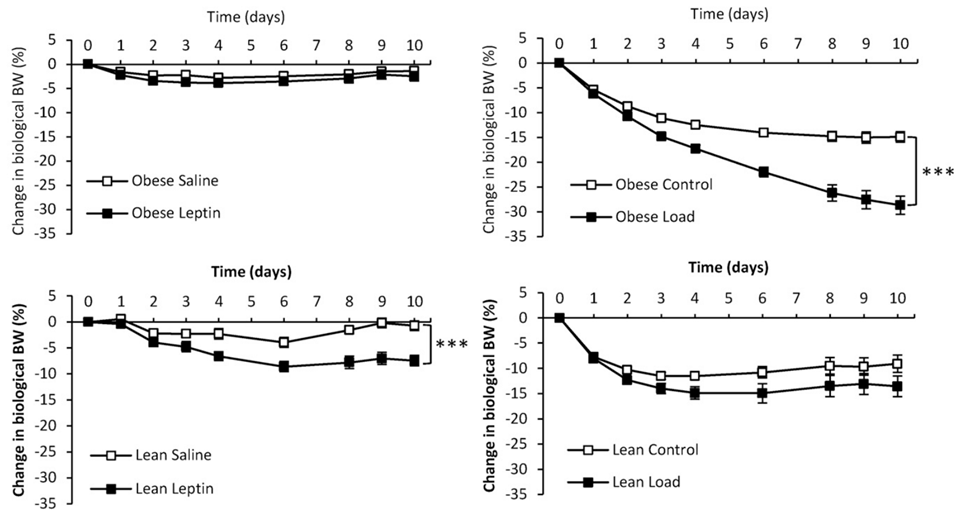
Swipe the chart to read it full size
Every panel works the same way, so look only at the gap between its two lines. Leptin barely touches the obese mice at top left, where both lines run together for all ten days. Give that same leptin to lean mice at bottom left and the treated group drops clear of the controls. Loading does the reverse. It opens a wide gap in the obese mice at top right and produces no significant gap in the lean mice at bottom right. Leptin, the hormone at the center of obesity research, works best on the bodies that need it least, and the bone sensor works best on the bodies that need it most.
69 People, Three Weeks, One Vest
In 2020, the team moved to humans. They recruited 69 adults with a BMI between 30 and 35 and randomized them into two groups. One group wore a heavy weighted vest at 11% of their body weight. The other wore a light vest at 1%. Both groups wore it for eight hours a day over three weeks. No exercise changes. No diet changes.
The heavy vest group lost 4.04% of their total fat mass. The light vest group lost 0.31%. The between-group difference was statistically significant at p = 0.000015.
Fat-free mass stayed the same in both groups. The vest burned fat and preserved muscle. (Ohlsson et al., eClinicalMedicine, 2020)
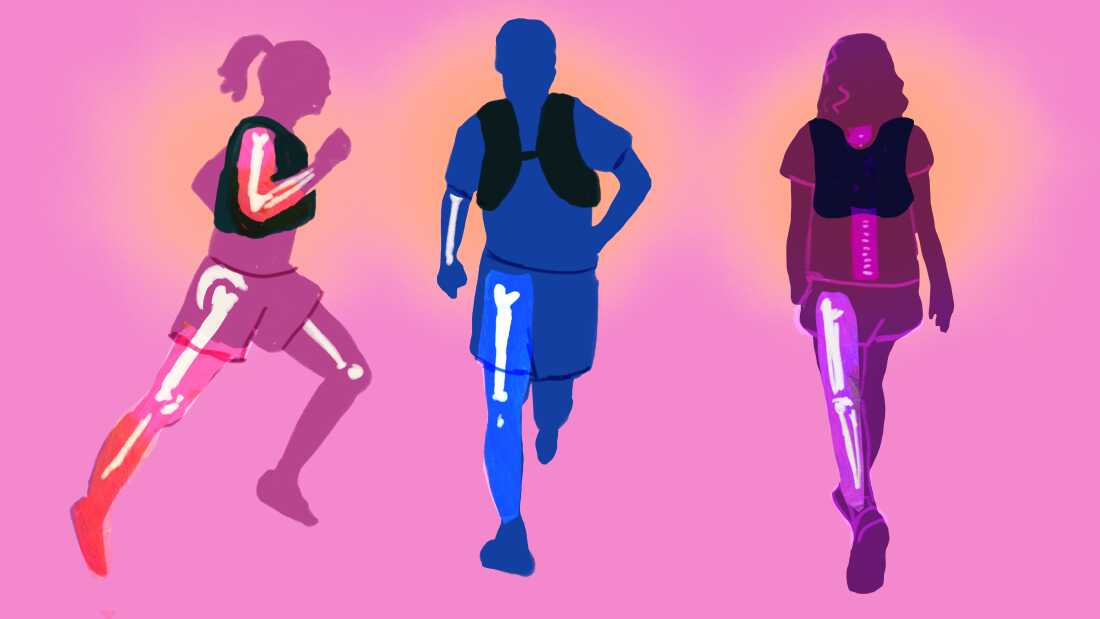
The Body Recomposition Nobody Expected
A larger trial in 2025 extended the protocol to five weeks. Same loading: 11% of body weight, eight hours a day, normal daily routine. This time the researchers used CT scans and doubly labeled water for precise measurement.
The scale did not move.
But the body underneath it had changed. Fat mass dropped 2.6%. Lean mass increased 1.4%. Waist circumference fell 2.3%.
The reason the number on the scale held steady: fat was leaving and muscle was arriving at roughly equal rates. A textbook body recomposition, produced by wearing a weighted vest and doing nothing else. (Bellman et al., BMC Medicine, 2025)
What Happened Two Years Later
A third trial asked the question that matters most: does it last?
Researchers at Wake Forest put older adults with obesity through a 12-month program. Three groups: diet alone, diet plus resistance training, and diet plus a weighted vest worn eight hours a day. Then they followed everyone for two more years.
The vest group preserved 147 more calories per day of resting metabolic rate than the diet-alone group. That is roughly the caloric cost of a 30-minute jog, preserved without jogging.
At the 24-month follow-up, weight regain told the full story.
The vest group kept nearly everything they lost. (Guida et al., Innovation in Aging, 2025)
What the Critics Say
The gravitostat is not settled science. Its own authors call it "a working hypothesis supported by some evidence." Fair reporting means putting the criticisms on the page.
The biggest challenge came in 2020 from a team that tested the theory using spaceflight and simulated weightlessness data. Rats in hindlimb suspension lost weight when the gravitostat predicts they should have gained it. Their counter-argument: the surgical implantation in the original mouse studies may have caused a stress response that mimicked the result. (Seneviratne et al., 2020)
The human trials are small: 69 and 59 participants. Neither could be blinded, because a 22-pound vest feels nothing like a 2-pound vest. The specific molecule osteocytes release to signal the brain has not been identified.
None of this invalidates the data. Three independent trials produced consistent outcomes: sustained loading reduces fat, preserves or builds lean mass, and holds metabolic rate. Whether the gravitostat fully explains the mechanism or is one piece of a larger puzzle, the practical protocol remains the same.
The EZ-VEST V2 loads standard Olympic plates, holds up to 300 lbs, and starts at $99. It is the only consumer vest built for sustained daily wear at the capacity and precision the gravitostat protocol requires.
Get the EZ-VESTThe Protocol (And the One Spec That Matters)
Every human trial used the same formula:
- Load: 11% of body weight
- Duration: 8 hours per day
- Activity: Normal daily routine (no extra exercise)
- Standing minimum: At least 2 hours upright per day
For a 200-pound person, 11% is 22 pounds. For 250 pounds, it is 27.5. For 180, it is 19.8.

The math is simple. Most weighted vests cannot do it. Standard fitness vests cap at 20 to 45 pounds, which covers the load for someone under roughly 200 pounds. Anyone heavier needs more capacity.
The protocol also demands precision. An 11% dose is not "about 20 pounds." It is a specific number that changes as your body weight changes. Proprietary weight inserts in fixed increments cannot hit it. Olympic plates can. A 10-pound plate, a 5-pound plate, and a 2.5-pound plate get you to 17.5 pounds exactly. Add or remove a fractional plate as your weight shifts.
For a detailed comparison of how five vests perform against this protocol, see our full test report.
| Spec | Protocol needs | EZ-VEST V2 |
|---|---|---|
| Max capacity | 22-33 lbs typical | 300 lbs |
| Weight precision | Exact to the pound | Olympic plates (1.25 lb increments) |
| Daily wear | 8 hours, normal activity | Built for all-day use |
| Cost per lb of capacity | Varies | $0.33-$1.00 (uses plates you own) |
| Adjustment speed | Must change as weight shifts | Swap a plate in seconds |
Kensui EZ-VEST V2
- Is this exercise or just wearing a vest?
- Passive. The trials required no exercise. Participants wore the vest during their normal daily routine.
- How much weight do I need?
- 11% of your body weight. Multiply your weight by 0.11. A 200 lb person loads 22 lbs.
- What plates fit the EZ-VEST?
- Standard Olympic plates. Any gym or sporting goods store carries them. The vest uses the plates you already own.
Sources
- Jansson J-O et al. Body weight homeostat that regulates fat mass independently of leptin in rats and mice. PNAS 115(2):427-432, 2018. PMC5777058
- Ohlsson C et al. Gravitostat Regulates Fat Mass in Obese Male Mice While Leptin Regulates Fat Mass in Lean Male Mice. Endocrinology 159(7):2676, 2018. doi:10.1210/en.2018-00307
- Ohlsson C et al. Increased weight loading reduces body weight and body fat in obese subjects. eClinicalMedicine, 2020. PMC7264953
- Bellman J et al. Increased weight-load improves body composition by reducing fat mass and waist circumference. BMC Medicine 23:317, 2025. doi:10.1186/s12916-025-04143-6
- Guida C et al. Weighted Vests Preserve Resting Energy Expenditure During Intentional Weight Loss in Older Adults. Innovation in Aging 9(Suppl 2), 2025. PMC12762967
- Seneviratne et al. Studies in microgravity, simulated microgravity and gravity do not support a gravitostat. J Endocrinology 247(3), 2020. doi:10.1530/JOE-20-0393
- Jansson J-O et al. The dual hypothesis of homeostatic body weight regulation. Phil Trans R Soc B, 2023. doi:10.1098/rstb.2022.0219
