The Dumbbell Hasn't Changed in 2,500 Years. An MIT Engineer Found the One Part Everyone Ignored.
Weight, handle, weight. The shape has survived every other change in training. The flaw hiding in it is about four centimetres long, and you have probably blamed yourself for it.

Note: The part of the dumbbell this story is about is the part with no weight on it. It holds nothing, lifts nothing, and adds nothing. It is also the reason you cannot rest an adjustable dumbbell on your knee, and the reason most of them stop being useful long before you stop getting stronger.

The oldest dumbbells we have are lumps of stone with a hole cut through the middle for your fingers. Greek athletes called them halteres. They swung them at the start of a long jump for momentum, trained with them the rest of the year, and thought enough of them to bury them alongside the men who threw well.
Pick one up in a museum and the strange thing is not how primitive it feels. It is how familiar. Mass at both ends, something to hold in the middle, nothing sticking out past your hand. Two and a half thousand years later, that is still exactly what a dumbbell is.
Almost everything else about training has been torn up and rebuilt since. Barbells got sleeves that spin. Cable machines arrived. Plates got calibrated to the gram. The dumbbell kept its shape because the shape was right.
I did not think about any of this until a loaded dumbbell left a mark on my thigh.

The Short Version
- Fixed dumbbells end where the weight ends. Adjustable ones do not.
- Almost every adjustable dumbbell leaves a threaded post sticking out past the plates, because it needs somewhere to put the collar.
- That post is what digs into your thigh, your forearm and the back of your neck, and it is why several ordinary lifts feel wrong with adjustable weights.
- Kensui's founder, an MIT engineer, moved the lock inside the stack so the dumbbell ends where the weight ends.
- The heavy version holds 300 lb across the pair, which is 150 lb in each hand, for $149.
Nobody Ever Questioned the End
Here is the thing about a fixed dumbbell. The weight is welded on, so the manufacturer can finish the handle exactly where the mass finishes. Nothing protrudes. That is why you can drop a 60 lb dumbbell onto your knee, kick it up into a press, and think nothing of it.
An adjustable dumbbell cannot do that, because the plates have to come off. Something has to hold them on, that something is usually a collar, and a collar needs bar to grip. So the bar keeps going past the last plate. Every spinlock handle ever made works this way. So do most of the loadable handles sold today.
That leftover inch or two of threaded steel does no work at all. It carries no load. It just waits at the end of the dumbbell, at exactly the height of whatever body part you were about to put underneath it.
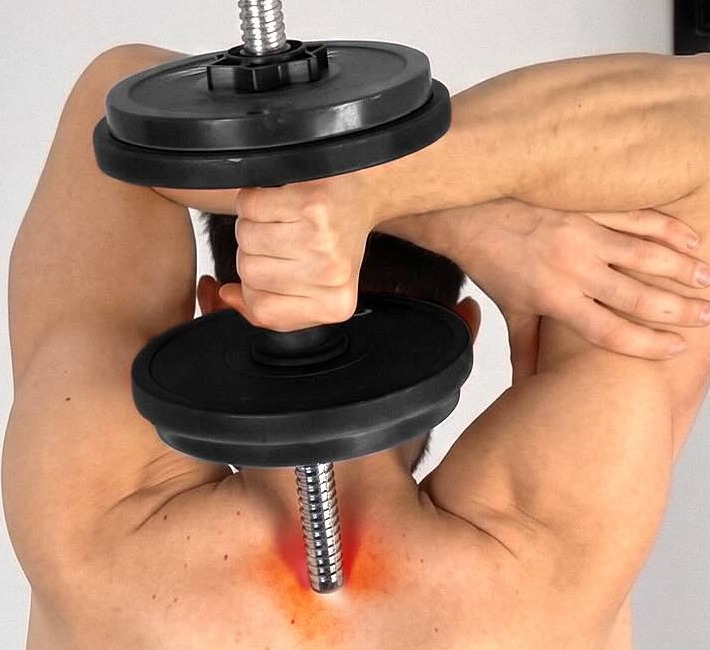
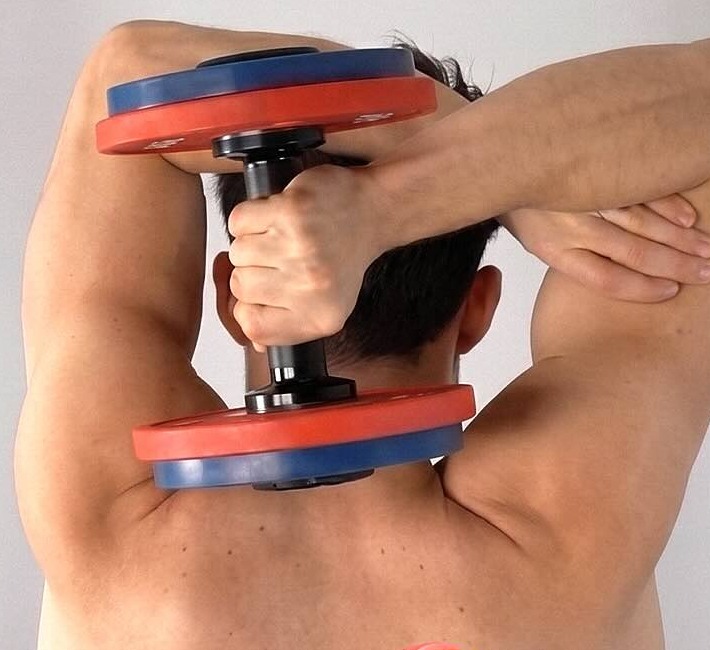
Three Moments You Have Blamed on Yourself
Once you know the post is there, you start noticing where it has been costing you. Ask anyone who has trained with adjustable dumbbells and you get the same three answers.
Kicking the weight up to bench. You rest the dumbbell on your thigh, drive your knee, and the end of the bar goes into the muscle. Most people quietly decide they are doing it wrong. They are doing it exactly right with a tool that has something in the way.
The overhead triceps extension. The dumbbell comes down behind your head, and the bottom end of the handle reaches your neck before your triceps reach a stretch. So you cut the range short and call it a day.
Heavy curls and rows. On the way up, the top of the stack meets your forearm. On a fixed dumbbell there is nothing there to meet.
They solve one of your biggest problems with adjustable dumbbells. The post that sticks out past the plates.
Nick Nilson, founder of Fitstep.comThe Engineer Who Went Looking for the Flaw
Remy Mock has two engineering degrees from MIT. He is also the person behind Kensui, a company that exists mostly because he kept finding equipment that almost worked.
His approach to the dumbbell was the same one he had already used on a weight vest. Take the object apart, find the constraint everyone has designed around instead of designing out, then move it. In this case the constraint was the collar. As long as the lock lives outside the plates, the handle has to stick out past them.
So the lock moved inward, into the stack itself, and the sleeve got short enough to disappear behind the plates. The result looks slightly wrong the first time you see it, in the way a lot of redesigned objects do. The stack simply stops, and the handle stops with it.

| AdaptaBELL MAX | Premium selectorized | Typical adjustable | |
|---|---|---|---|
| Price | $149 a pair | $1,299.99 a pair | $300 to $400 a pair |
| Load in each hand | 150 lb | 105 lb | 50 to 90 lb |
| End of the handle | Flush with the plates | Flush | Post sticks out past the stack |
| Uses plates you own | Yes, 28mm and 50mm | No, proprietary plates | Sometimes, one bore only |
| Buying the weight twice | No | Yes | Yes |
Premium selectorized column is the REP x PÉPIN FAST Series 105 lb pair, priced on repfitness.com. Typical adjustable is the mainstream dial and pin category.
The heavy version is the one this story is really about. Knurled aluminium, 38mm grip, and 150 lb of capacity in each hand.
Get the AdaptaBELL$149 a pair, against $1,299.99 for a selectorized set that stops 45 lb per hand sooner.
What You Get Back
The honest summary of a flush end is that it gives you back lifts you already knew how to do. You can rest the dumbbells on your knees between sets. You can press overhead without ducking. You can take a curl through its whole range.
There is a second thing that only shows up later. Because the plates sit against each other rather than against a stub, the loaded stack is shorter, which makes the whole dumbbell easier to control at heavy weights.

How Heavy Is Heavy Enough
This is where I want to be careful, because the number is easy to overstate. The MAX is rated at 300 lb across the pair. That works out to 150 lb in each hand. It is not a 300 lb dumbbell, and anybody telling you otherwise has read the box wrong.
Even so, 150 lb in each hand is more than most people will ever use, and it is far past where the dial-and-pin category gives up. Those sets typically stop between 50 and 90 lb per hand. The premium machined set in the table above stops at 105.
Plenty of loadable steel handles go higher than 150. Some take 400 lb per handle. What they do not do is finish flush, take both plate bores, or cost $149 for the pair, which is the trade this particular design is making.

The Part That Has Not Changed
None of this makes the dumbbell a new invention. It is still weight, handle, weight, which is what a Greek athlete would have recognised and what the mosaic at the top of this page shows a Roman one holding around AD 320.
The change is that the adjustable version finally matches the fixed one. For most of the last century, choosing adjustable meant accepting a piece of hardware sticking out of the end of your dumbbell and quietly adjusting your training around it. That was never a law of physics. It was a collar in an inconvenient place.
The Dumbbell That Ends Where the Weight Ends
Loads 28mm and 50mm plates on the same handle. Knurled aluminium, flush ends, 150 lb of capacity in each hand, sold as a pair.
Get the AdaptaBELL- Do I need Olympic plates?
- No. The same handle takes 28mm standard and 50mm Olympic, so whatever is on your rack already fits.
- Is 150 lb per hand or per pair?
- Per hand. The pair is rated 300 lb in total, and the lighter PRO is 140 lb across the pair.
- What if I hate them?
- There is a 100-day money-back trial, so the decision is reversible for longer than most training blocks.
